 VapeWholesaleHub
21700 Battery Packaging Refresh Without Losing Recognition — Three Price Tiers
There is no clever trick to buying 21700 battery well. There is a short list of things worth checking and a long list of things that distract from them. This page is an attempt at the short list.
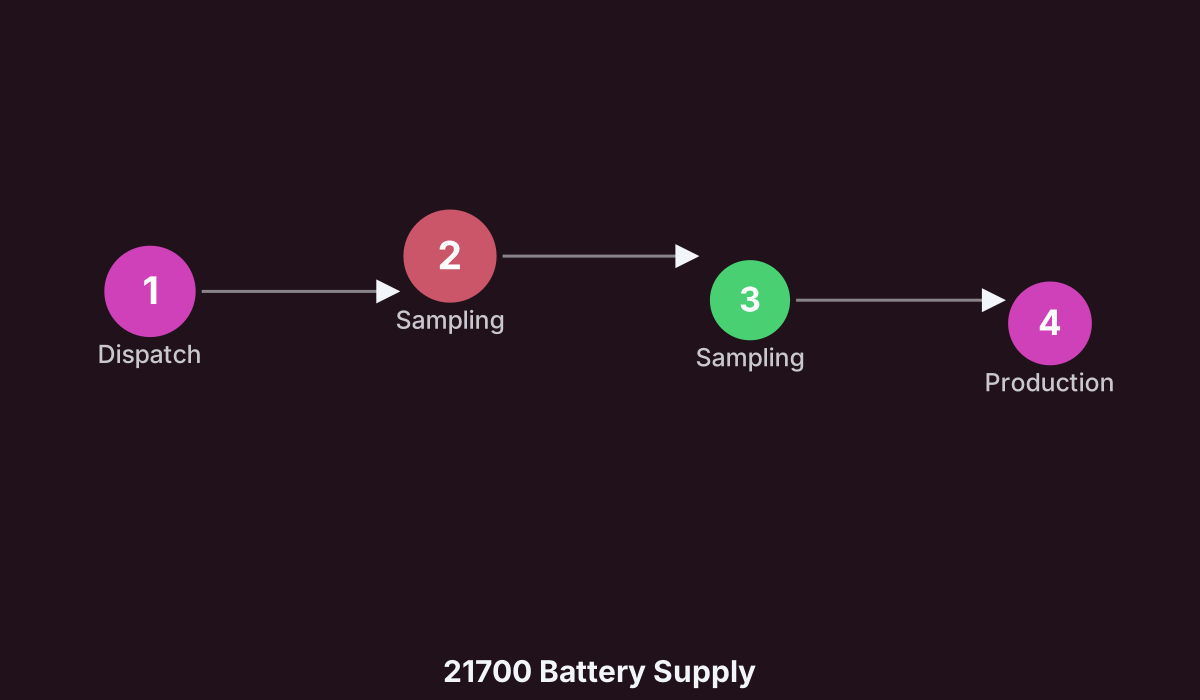
Pricing and Margin
Hold a small 21700 battery buffer in your pricing model for currency movement. A few percent on a container is a real number, and it is easier to plan for than to absorb.
Watch the 21700 battery price you pay over a year rather than per order. Factories respond well to visible volume, and a quarterly review is usually worth more than a hard negotiation each time.
Indicative reference points for planning purposes: entry tier from USD 1.98 per unit at 2000 units, mid tier at USD 1.49, and volume tier at USD 1.07 for full container quantities. These figures move with specification, packaging and freight, so treat them as a shape rather than a quote.
Getting 21700 Battery to Your Warehouse
Consolidating 21700 battery with other lines is often the biggest single saving available to a mid size importer. The unit cost does not change but the landed cost does, sometimes materially.
Model 21700 battery freight both ways before choosing a method: cost per unit and cost per week of delay. The second figure is the one that decides whether a cheap option was actually cheap.
Market Signals
Flavour cycles in 21700 battery are shortening, which argues for smaller test orders and faster feedback loops rather than large speculative buys on a predicted winner.
Where 21700 Battery Sits in the Range
Category data for 21700 battery is noisier than it looks. Promotions, weather and local competition all move weekly numbers, so read three months at a time rather than reacting to a single week.
Category planning for 21700 battery works best when you map it against three shopper types: the restocker who already knows what they want, the switcher who wants something stronger, and the explorer who buys on flavour name alone.
Reading a 21700 Battery Spec Sheet
When we write a 21700 battery specification with a distributor, we fix four things first: the resistance band, the liquid capacity tolerance, the puff count methodology and the packaging master carton. Everything else can flex without changing the customer experience.
Specification sheets are where a 21700 battery deal is won or quietly lost. Two samples can look and taste the same while using different coil wire, different wicking density and different tolerances on the mouthpiece. Those details decide how the unit behaves in week three rather than minute three.
| Product category | Closed pod |
|---|---|
| Resistance band | 0.6 - 0.8 ohm |
| Capacity tolerance | +/- 5% |
| Puff count method | Machine cycle 2s on / 18s off |
| Master carton | 120 units |
| Carton weight | 6.0 kg |
| Shelf life | 12 months |
| Storage | 15-25 C, dry, away from direct light |
Practical Checklist
- Rotate stock by batch code rather than by delivery date.
- Check carton dimensions against your freight quote before confirming.
- Confirm the current customs classification with your own broker.
- Model landed cost, not ex-works price, when comparing quotes.
- Plan the switch from air to sea freight before you need it.
- Keep sealed retained samples from every production batch.
Frequently Asked Questions
What information do you need to quote?
Target specification, approximate quantity, destination and any packaging requirement. With those four we can usually come back with a costed option the same working day rather than a request for more information.
What happens if my market changes its rules?
Regulations move, and packaging or documentation sometimes has to follow. We keep approved artwork files on hand so that a required change is a reprint rather than a redesign, which keeps the cost and delay down.
What if a batch does not match the sample?
Keep the retained samples from the approval stage. If a delivered batch measurably differs, we compare against the retained set and resolve it against the production record. This is why we insist on sealed retained units from every run.
Do you hold stock for regular customers?
For established programmes we can reserve production slots and, in some cases, hold finished 21700 battery stock against a forecast. It removes most of the lead time risk from a reorder and is worth discussing once volumes are stable.
Can I mix strengths in one order?
In most cases yes, as long as each strength meets the minimum run length. Mixed strength cartons are popular with retailers building their first display because they show the full ladder without over committing.
Next Step
The best 21700 battery programmes we see are run by buyers who write things down. Specifications, batch records, complaint thresholds - the paperwork is the advantage.
Related Reading
- 21700 Battery Growing From Pallet to Container — North America
- 21700 Battery Temperature Exposure During Transit — Updated for 2026
- 21700 Battery Tooling and Moulding Cost Structures — Tight Margin Categories
- What a 21700 Battery Production Slot Really Means — the Middle East
- 21700 Battery Packaging Waste and Recycling Options — Freight Included
- 21700 Battery Humidity Control in Coastal Warehouses — 2026 Buyer Notes